
Water causes unattractive spots on wooden floors. However, what you notice is seldom the bigger issue. For instance, just one dry-to-the-hand plank can harbor up to 20% excessive moisture – and that’s where potential warping, fungi, and weaknesses develop over time.
The real danger is if a substantial amount trickles through to the subfloor. In such cases, surface dryness doesn’t matter. A hygrometer or a pin-type moisture gauge helps you understand the true condition of the wood. Otherwise, you’re just estimating.
For example, if the edges of the planks rise higher than the center, moisture has entered from beneath the board. If the center rises higher, the edges have taken the hit. Neither scenario is optimal: they indicate that the moisture isn’t dissipating uniformly, which is the second phase of drying. If the core remains moist while the surroundings are bone-dry, the planking won’t shrink back into shape.
The difference between evaporation and drying
Most people think that airflow alone can dry out any floor, but that’s not entirely accurate. Airflow, caused by a fan, can help to lift moisture off the surface but will not be able to draw out “bound” water. The air-dry moisture that’s locked within the wood cells themselves. To do that, you need an LGR (Low Grain Refrigerant) dehumidifier which removes moisture from already dehumidified air.
Professional restoration companies will use high velocity air movers alongside LGR dehumidifiers. The air movers agitate the air at the floor level, while the dehumidifier continually takes the moisture out of that agitated air. The air mover’s volume in cubic feet per minute (CFM) adds to the volume of air that the dehumidifier can process per minute. This creates a kind of low-pressure area directly over the wet wood which helps to lift the bound water up and out.
Regional conditions change the drying timeline
Wood dries until it reaches the equilibrium moisture content (EMC), where it no longer gives up moisture to the air or absorbs it. But that EMC can vary significantly based on local atmospheric conditions. A floor might reach an EMC of 12% in a humid coastal environment and 6% in a high desert environment in the same amount of time – but then react to a sudden change in either environment with shrinkage or swelling.
But slowing down wood drying, even when necessary, is also fraught with risks. Mold, mildew, and insect infestations can take hold on piles of standing wood, especially in a warm, moist climate, and even in cooler, drier climates. That’s why localized knowledge is part of the technical picture. Water Restoration Denver teams, for example, work in conditions where high altitude and low humidity can accelerate surface drying while the subfloor remains saturated – a combination that produces cupping, cracking, and mold growth in the same job if drying equipment isn’t calibrated correctly for the environment.
As a result, velocity and intensity of drying make a huge difference. Drying oak too quickly can cause honeycombing, where microscopic cells at the fiber ends rupture and leave a honeycomb pattern on the end-grain surface. Drying too quickly can also cause internal checking, which only shows up months or years after a floor is installed as unexplained splits deep inside the wood.
Mat drying and injection systems
To save high-end floors that cannot be torn up, technology used in mat drying can do the trick. Sealed panels are placed and attached to the floor, creating a vacuum that pulls moisture from above through the grains in the wood without damaging the installation, allowing the finished floor to act as a drying panel. This technology doesn’t work against the natural structure of the wood, but with it.
When the subfloor is wet and the finished and/or unfinished floor cannot be taken up, injection drying systems are employed. Conditioned air is injected through small access holes or existing gaps that draw in outside air. This forces air movement in the cavity under the planks and dries both the subfloor and the underside of the hardwood.
If the worst comes to pass, pressure relief cuts could be necessary. Shallow cuts are made between the planks so the wood has room to expand and move while avoiding catastrophic buckling. They are rarely used, but they can turn an otherwise doomed floor into a salvageable one.
Mold risk, refinishing, and the waiting period
Mold can form on subflooring within 24 hours of exposure to water. If you don’t check what’s happening underneath the boards, you’re making a dangerous assumption that everything dried in place – especially if the space is enclosed, poorly ventilated, and dark. Microbial growth in a subfloor cavity is particularly dangerous: it’s invisible until it’s extensive; it’s spreading from a concealed location straight into living space; and it makes the finished surface a constant substrate for its invisible creepy-crawlies to party on until the host material is ruined. By the time you can smell it, remediation is a larger and more expensive project than the original water damage ever would have been.
If you treated the underlying cause and brought in a restoration team in time, hopefully, the damage isn’t dire and drying out the subfloor can save it. Despite being a lot of moisture-absorbent material squeezed into a slim space, solid wood has surprisingly minimal wicking ability once it’s saturated. The same qualities that make it so great for making furniture and floors make it terrible at quickly sucking up water: it’s strong, smooth, and sealed in place, so the water can’t migrate easily within it. Residents like that about it. Microbes not so much.
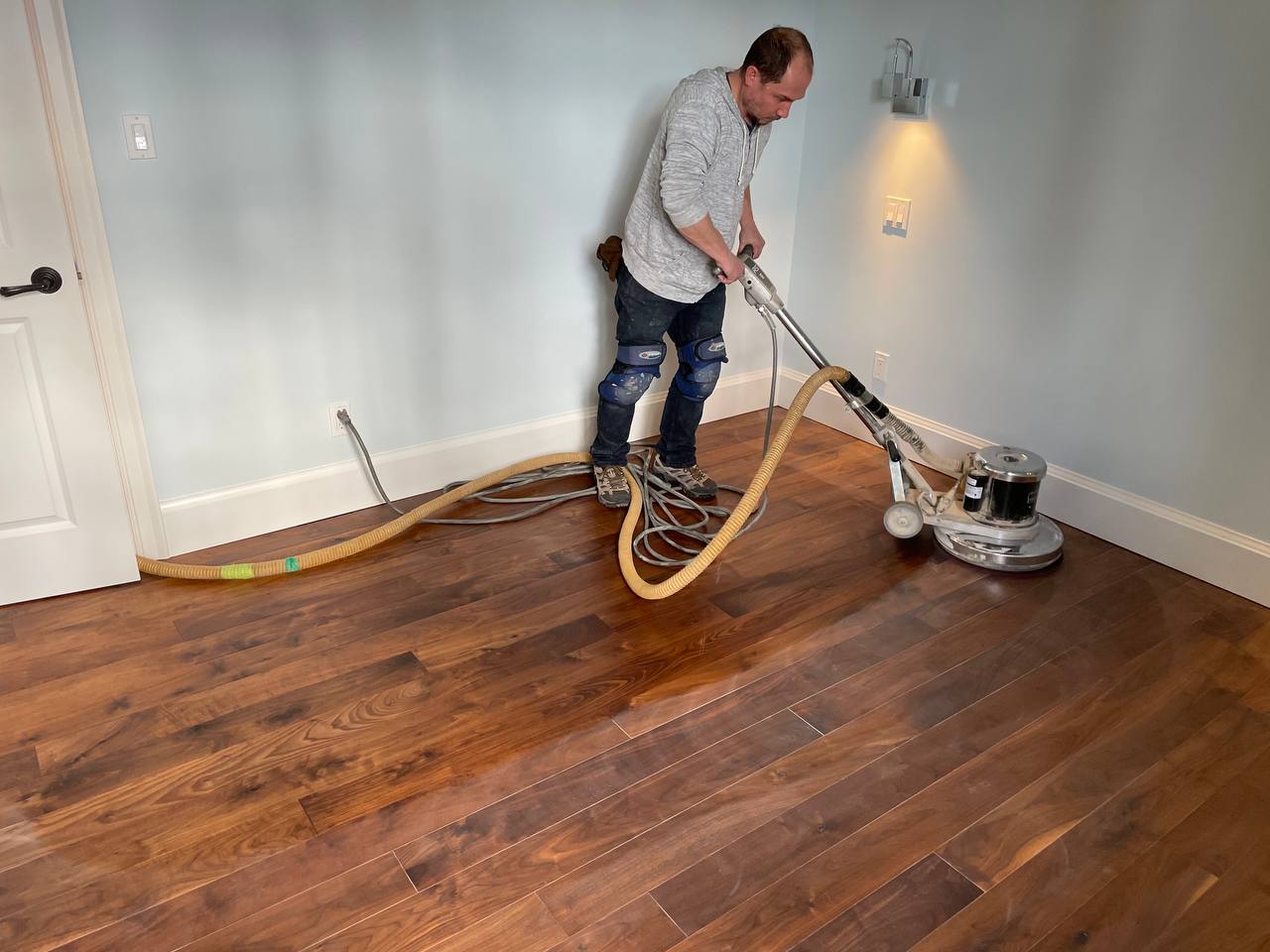
But solid hardwood subfloor, it should be noted, depends entirely on refinishing the surface to be effectively remediated. This process – sanding back the surface and applying a new polyurethane finish – must wait until the floor has dried sufficiently. The recent advances in water damage restoration technology have replaced the historical rule of thumb with actual measurement.