
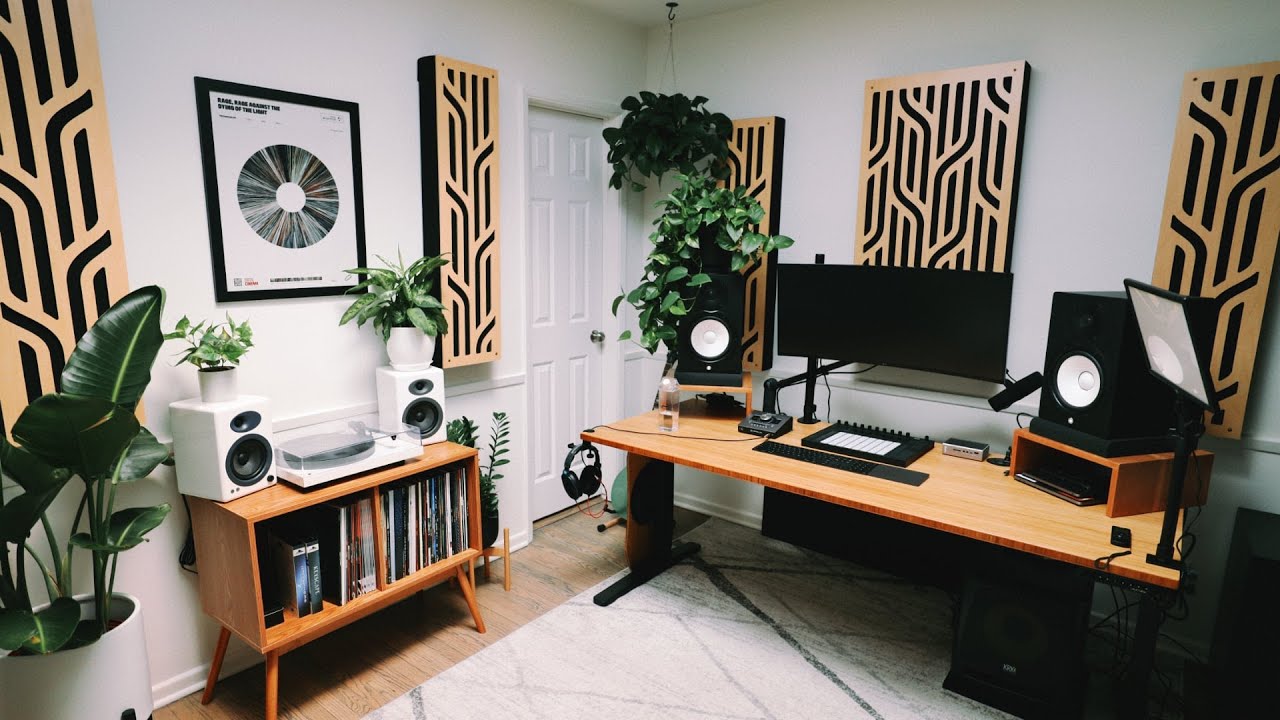
Many individuals who are planning to have a music room in their home first search the word “soundproofing” to realize they actually need “acoustic treatment” – it’s another issue with another solution. Soundproofing prevents sound from leaving or entering a room. Acoustic treatment, on the other hand, alters how sound functions once it enters the room. If you are not rehearsing with a drum set at midnight in a townhouse, you’ll benefit from the latter as it will truly improve the sound of your piano and your playing experience.
It’s important to differentiate between the two because it will determine where your money and sweat equity will ultimately go. Soundproofing requires more mass, decoupling walls, and sealed doors which translates into costly construction work. Acoustic treatment demands panels, smart placement, and a couple of household solutions which most people can easily implement over a weekend. This article focuses on the latter, and will include enough principles so that your choices will seem more obvious and less random.
Start with placement, not panels
Before you commit to purchasing any foam panel or fabric frame, move the piano. Where you put it does more for the sound quality of an acoustic instrument than anything else you can do, no matter how much money you throw at “treatment” afterwards.
Keep it away from corners. Reflecting bass energy muddles your sound like nothing else. Keep it off bare exterior walls, which are cold and too often humid. Pianos are delicate things. You need to keep them warm and safe.
If it’s a grand, you want to orient the piano so that the open lid points into the room. Grands project sound up and out from that lid and into the room. If it’s an upright, the sound gets projected out the back of the instrument, off the wall behind it, which means an upright a few inches off the wall (not flush against it) will sound noticeably clearer than one crammed into a corner. This is the unglamorous part of room design and it’s also the part people skip. It always feels like you aren’t doing anything. But no acoustic panel fixes a badly placed piano. Get that right first.
Treat the first reflection points
Once you have the piano safely in place, you’ll want to determine the spots on the walls where the sound bounces and then reaches your ears before your walls do. These are the first reflection points and will be, more or less, the two walls at your ears’ height while you’re sitting in front of the piano, plus the ceiling above you.
Sound will naturally disperse from its point of origin as waves, but more percussive sounds will tend to travel in a straight line to your ear and then bounce and disperse. This is especially true in smaller rooms and for higher frequencies that define the piano’s tone. That bounce will reach your ear a tiny fraction of a second after the direct sound and blur your hearing of it. Realising the sound of your piano is being dampened by your walls will come as a revelation, we promise – unless the piano is already there for show.
A 50-100mm absorption panel at each first reflection point will make a world of difference – you’re not treating harder, late-arriving reflections or absorbing the vital, mood-creating reverberation of the room. If you want to Browse Kawai at Broughton Pianos before committing to a room setup, that’s a smart move too – but for now, it really is only a small, discrete panel on your wall, not an entire wall of any panel or substance you like. Fabric-wrapped panels are the default for this very reason, and they come in enough colours and textures to look like wall art rather than sound treatment – important given that this also has to be a living room.
Corners need bass traps, not panels
While flat absorption panels can help to absorb mid and high frequencies, they are not effective for dealing with low frequencies such as bass. Low frequencies tend to accumulate in corners where walls meet, and this phenomenon is known as a standing wave or room mode.
For a small rectangular room, which is often the case for many home music rooms, standing waves cause certain bass notes to resonate while others sound weaker or are masked. This is particularly noticeable in the bottom octave of a piano. Bass traps installed vertically in room corners from floor to ceiling are designed to absorb low-end frequencies. They help even out the bass response so that all notes sound clearly with the same volume, from the top to the bottom of the keyboard.
Don’t over-treat the room
Many end up doing this wrong at home. When they realize “oh, absorption panels work”, the move is to try and slap every possible surface. In the end, you get a room that just sounds flat and lifeless – it is “clean”, but sounds nothing like a piano in a room.
A completely dead room completely kills that natural resonance that makes a piano sound warm and alive. You’re looking for a reverberation time somewhere around 0.4 to 0.5 seconds – short enough that the sound doesn’t get muddy, but long enough that the room still has some life in it. Concert halls run several seconds of reverb; a small domestic room needs nowhere near that, but zero isn’t the target either.
The solution, of course, is to balance your absorption with diffusion, because diffusion takes reflected sound and scatters it instead of just soaking it up. This gives you that nice, open feeling, and not the horrible slap-back echo you get from two parallel bare walls. An open bookshelf with irregular bric-a-brac on it is a genuinely effective diffuser. So is a room with some upholstered furniture, and some curtains, and some different surface materials, rather than four flat, hard walls.
Use the furniture you already own
Before you spend a dime on anything specialist, see what you’ve got in the room. Room geometry and furniture placement are the cheapest acoustic tools there are, and most people underuse them.
A thick wool rug on hard flooring underneath and around the piano removes a surprising amount of slap echo that hard floors create. Heavy, lined curtains over any glass in the room are one of the most effective absorbers you can buy, and unlike acoustic panels, nobody will ever ask why you have them. Bookshelves, sofas and soft furnishings all do double duty as both absorption and diffusion depending on their shape and material. If you’re renting, or just not ready to commit to mounted panels, this is where to start – and it often gets you most of the way there.
Choosing the right piano for the room you’ve got
Treating the room is only half the problem. The other half is working out what sort of instrument the space will actually support.
An acoustic upright or grand rewards a music room: somewhere you can play without needing to worry what’s through the next wall or what time it’s getting to. If you’ve got that space – a converted garage for example, or an unoccupied bedroom with reasonable isolation, or simply a house with no other residents in it – then an acoustic piano, well placed, is going to deliver you the richest sound and the most satisfying touch. Equally, if being honest, you just want to fill that one available room in your apartment with a grand, then we salute your spirit and invite you to carry on as you were.
If on the other hand, the music room is also a spare bedroom, or an apartment through which neighbours will hear you, or a room where the rest of the family spend their evening, then a hybrid or digital can often be the more honest fit. Modern hybrids use genuine acoustic hammer actions paired with digital sound generation, which means you get a real piano feel with the option of silent, headphone-based practice whenever the room needs to stay quiet. Kawai’s hybrid ranges are a good example of the category – a wooden-key action that behaves like an acoustic instrument, in a smaller footprint and with a more contained sound profile that works with shared walls or smaller apartments.
Again, we’re not here to say you’re doing it wrong. A room with a grand in it is a life goal for many of us too. It’s just a decision that you want to be making based on how the room and household already operate, not just by deciding an acoustic has more status and so you’ll make room for it no matter the cost.
Humidity is part of the room’s job too
Attention always goes to what you see first – which is why the acoustic panels get all the focus. But the longer-term, quieter, more insidious damage to your piano comes right out of sight.
The soundboard is wood. And wood moves according to how much moisture is in it. Outside the right range of moisture, sustained swings cause the soundboard to swell and contract, which throws the instrument out of tune faster and, over years, can cause cracking or structural damage that’s expensive to repair.
A hygrometer in the piano room costs very little and tells you immediately if you’ve got a problem. If your climate swings seasonally, a basic humidifier or dehumidifier for that one room is a small investment against the cost of soundboard repairs or a piano that never quite holds its tuning. Treat this as part of the room’s design brief, not an afterthought. The panels make the piano sound better today. Humidity control keeps it sounding good in ten years.
Make it look like a room, not a studio
The best music rooms I’ve been in are ones that, at first glance, don’t look like they have much thought put into acoustics at all. There’s a rug, there’s curtains, the door looks like it probably didn’t come from the hardware store, but these are all things that one would expect in a nicely-appointed space that has nothing to do with music. And that’s the point – the goal isn’t making the room dead, it’s making the room somewhere you’d like to sit.
Door seals and a rug under the door threshold cut down sound transfer to the rest of the house without any visible sign they’re there. Fabric-wrapped panels in colours that match your existing decor do acoustic work while looking like framed art. A nice lamp near the piano, a plant, a couple of your favorite pictures that have sat forgotten in the closet for a few years – put a few of those in the room and you’ve absorbed plenty of sound right there. Layered lighting and personal touches make the room feel like somewhere to linger, which matters more than any RT60 number if the actual goal is spending more time playing.
The room should make you want to sit down and play
Everything does not have to be flawless. A room that has a piano that makes sense, a few properly positioned panels, corner bass traps, a good rug, and stable humidity will already sound way better than a room with no treatment at all, and it should still look inviting. The idea is not to create a recording studio. This is a room that is centered around the piano, where the sound and the room complement each other rather than compete.