
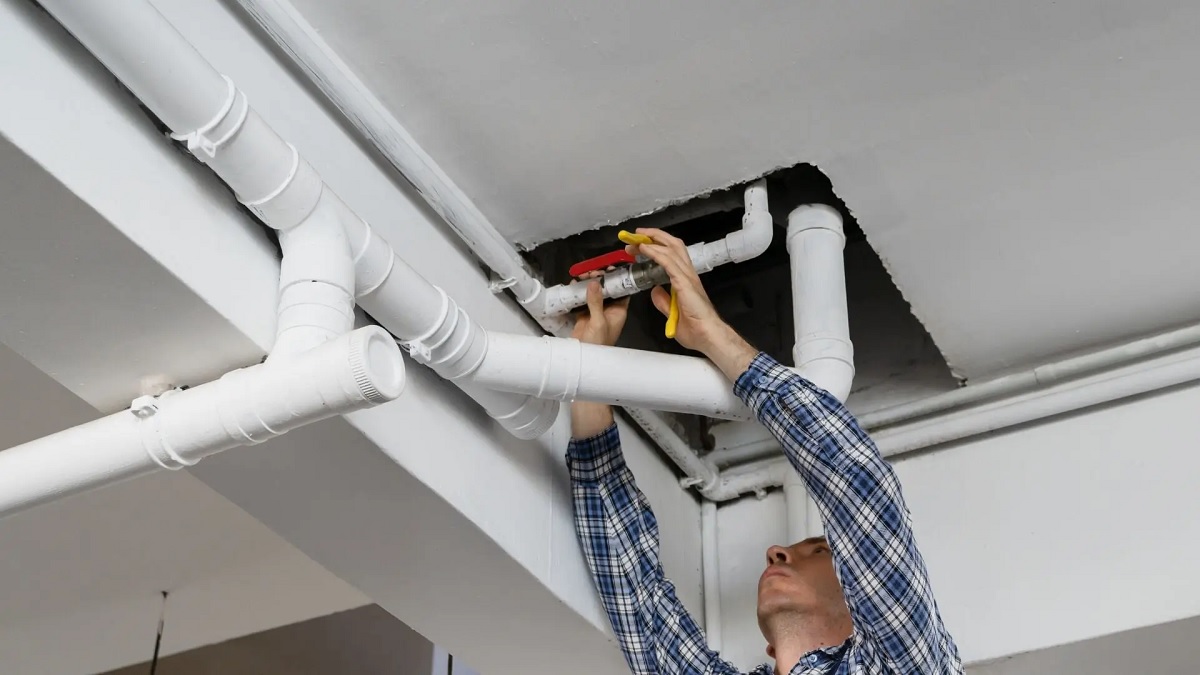
When a pipe bursts, it causes immediate damage. The stress on the drywall, ceilings, and floors as they absorb as much water as they can is evident from the warping and buckling. Water can also wick up drywall, insulation, and studs within minutes, causing even more damage. In under an hour, metals begin to corrode, and microbial growth starts.
Then, as time passes, the various building materials begin to turn on each other. The trapped moisture in the wall assembly reaches an equilibrium, and water begins to evaporate into the wall cavities and ceilings. The materials that absorbed the most water in the burst become the wet-bulb, now causing further damage to the dry areas.
The wicking effect and why walls lie to you
Water doesn’t stop at the floor. Porous materials such as drywall, fiberglass insulation, and wood framing draw moisture upward through capillary action – a process called the wicking effect. In a typical wall cavity, water can travel two to three feet above the visible flood line before it slows down. The studs and sill plate (the lowest horizontal wood member of the frame wall) absorb that moisture silently, with no visible staining on the painted surface.
This is why a wall that looks dry to the eye can be saturated inside. Professional moisture mapping uses thermal imaging cameras and calibrated moisture meters to locate that hidden water. Skipping this step is one of the most common reasons homeowners end up with structural wood rot or mold growth months after they thought the problem was resolved.
The 24-48 hour window is real
Mold and mildew can begin to grow on damp surfaces within 24 to 48 hours, significantly increasing the cost and complexity of structural repairs. That’s not a scare tactic – it’s microbiology. Organic building materials like OSB, plywood, and framing lumber provide exactly the nutrients fungal growth needs, and elevated moisture content is the only other variable required.
Once microbial growth establishes itself in structural members, the remediation protocol changes. You’re no longer just drying – you’re dealing with contaminated material that may need to be removed entirely. Acting within that first window is the difference between a drying project and a demolition project.
What’s happening under your floors
Non-porous flooring such as laminate, luxury vinyl, and tile with sealed grout, becomes a trap. Water that wicks or is forced beneath non-porous flooring has no path to evaporate and escape, so it remains in continual contact with the subfloor. Plywood and OSB (oriented strand board) underlayment will naturally begin to swell and delaminate while losing structural (load-bearing) capacity. Delamination simply means the bonded layers of the material are separating, and once that occurs the subfloor is no longer structurally restorable no matter how dry you can get it.
Simply throwing a few air movers on the floor won’t cut it. Injecting and flowing conditioned air through the appropriate drying equipment directly into the cavity beneath the floor is one advanced method. Teams like United Water Restoration of Denver NW use industrial LGR (Low Grain Refrigerant) dehumidifiers to generate deeply dehumidified air to pull moisture from within the structural assemblies rather than continually cycling surface air.
This is where psychrometry comes into play – specifically utilizing the sensitively engineered equipment response to manage the interplay of temperature, humidity, and airflow to actually dry the structure, not just superficially dry it out.
Foundation risks that don’t show up immediately
When a block foundation wall is wet, that moisture is also wicking into the block cores, which hold ambient humidity within your basement and promote the growth of unhealthy mold. Split-face blocks are those architectural concrete masonry units with a rough, stone-like texture on one or more faces. These tend to collect scads of dirt harboring biological growth and bug colonies.
Bugs are better than your kids at finding every opening in a block foundation wall for squeezing through into your basement. Just as the efflorescence forms on the inside face of the blocks, the pressure of groundwater pushes mold, dirt, and bug habitats through the open cores to litter your basement floor with strange filth.
“Dry to the touch” isn’t a standard
This is the part that most home and property owners miss. They assume that because the water came in contact with a material that has since dried, that material must be dry. Unfortunately, that’s not exactly how it works. If the materials weren’t abnormally wet to begin with, they wouldn’t have been damaged abnormally fast once they got wet.
Wet takes time…and time is what most drying contractors don’t factor into their bids. The time it takes to actually dry the water out of the wet building assembly while it’s still in place, saving you the extra costs of tear-out and repair – costs you’ll have to bear if mold develops in the assembly due to inadequate drying post-deluge.
A pipe burst gives water a path into your building. What happens next depends on how fast you respond and whether the response goes deep enough to match where the water actually went.